At the event, the ministry provided information on its coordination with other ministries and sectors in implementing solutions to ensure that rice production and exports remain aligned with market developments, while simultaneously supporting farmers and enterprises engaged in procurement.
    |
 |
|
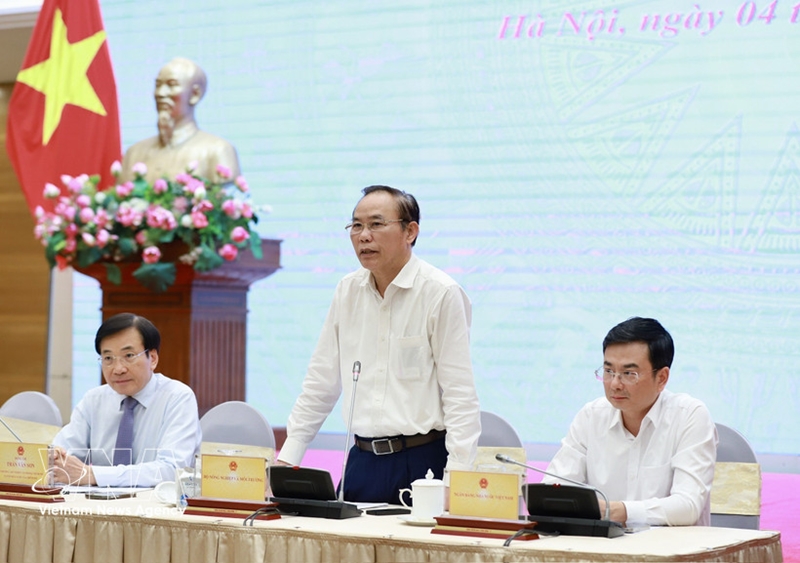
Deputy Minister of Agriculture and Environment Phung Duc Tien speaks at the Government’s regular March press briefing held in Hanoi on April 4. |
Accordingly, between January and March, rice output reached 3.64 million tonnes; livestock production attained 2.28 million tonnes of meat, up 4.9%; fisheries output reached 2.7 million tonnes, up 3.3%; and forestry production totalled 12 million cubic metres of timber, an increase of over 3%. The sector’s export turnover reached 16.69 billion USD, up 5.9%, with a trade surplus of 4.78 billion USD, up 12%.
Deputy Minister of Agriculture and Environment Phung Duc Tien said that, in light of impacts stemming from the situation in the Middle East, rising prices of fuel, fertilisers, and plant protection products, and lower rice prices compared with 2023, on March 11, the ministry advised the Prime Minister to issue a dispatch on the management of rice production and consumption under the new circumstances. Prior to this, however, the ministry had already focused on a number of fundamental and stabilising tasks.
With between 85% - 89% of rice varieties being of high quality, yet amid increasingly competitive export conditions, Vietnam must continue to implement science and technology programmes, focusing on factors such as short growth cycles, rapid harvesting, and high quality, he noted, adding that such measures have been pursued consistently over many years.
The development of databases and digital transformation is also being implemented in a highly resolute manner, Tien added.
The deputy minister further shared that emissions reduction will not be limited to the one million hectares of high-quality rice. In the time ahead, there will be both practical and scientific foundations to expand implementation to the southeast region, the south central coast, the northern midlands and mountainous region, the Red River Delta, and nationwide, thereby advancing emissions reduction in line with the country’s commitment to achieve net-zero emissions by 2050.
According to the official, provinces and cities have also forged linkages with enterprises to support procurement, storage, processing, and deep processing for market supply, in a bid to establish an ecosystem for the sustainable handling and development of the rice sector.
Source: VNA