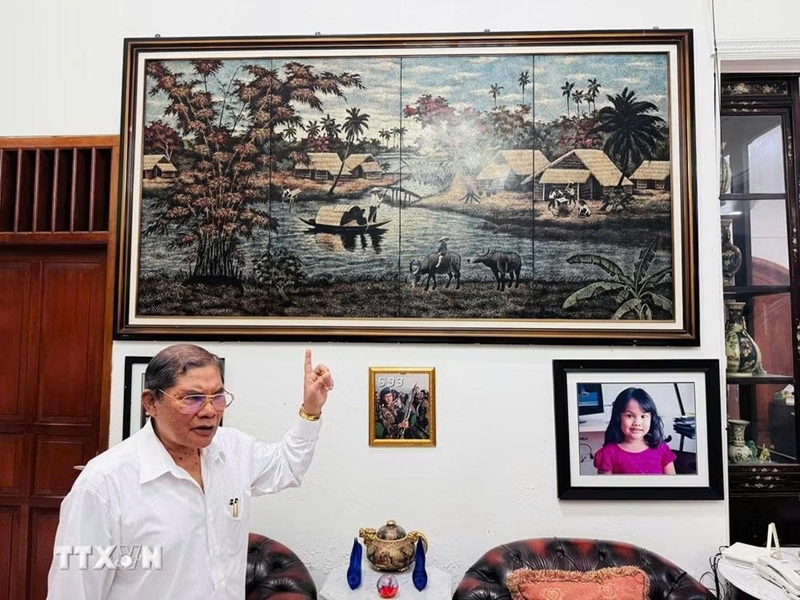
At the entrance, a large lacquer painting composed of four panels vividly depicting a traditional Vietnamese rural market immediately draws attention. Sianipar said it is among his most treasured pieces. Although he has been offered tens of millions of rupiah for the painting on multiple occasions, he has firmly refused to sell it, choosing instead to keep it as an irreplaceable part of his memories.
    |
 |
|
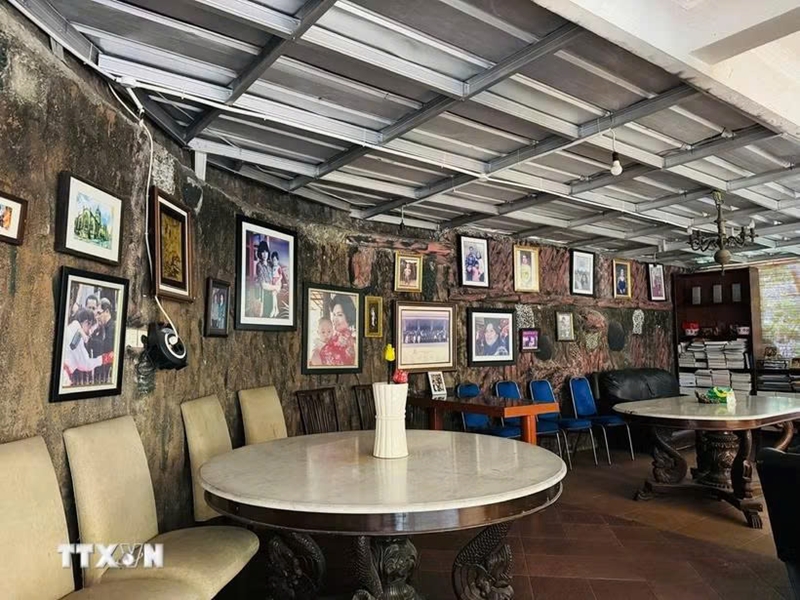
Not for its architecture, but for its interior, a more than 500-square-meter space, is arranged like a miniature “Vietnam museum,” preserving hundreds of memorabilia from Lumban Sianipar's years living and working in Hanoi |
Inside, the house unfolds as a cultural journey through Vietnam, with walls adorned with mother-of-pearl inlay works, eggshell art, lacquer and oil paintings. Intricately crafted wooden cabinets, Bat Trang ceramics and various handicrafts are thoughtfully arranged, creating a space that is both elegant and warmly imbued with Vietnamese character.
Sianipar takes pride in these items, which are closely tied to his tenure in Vietnam as Indonesia’s Defense Attaché. His family lived on Ngo Quyen street from 1994 to 1997, a period when Hanoi was undergoing transformation in the wake of the “Doi Moi” (Renewal) scheme. For him, it was a peaceful and fulfilling chapter, despite being far from home. His wife and three children still recall Hanoi’s quiet streets, craft shops and distinctive cuisine.
Revisiting his memories in late April, he vividly recalled festive streets adorned with flags, particularly the solemn atmosphere marking the 20th anniversary of the Liberation of the South and National Reunification Day (April 30, 1975). Military parades and crowds filled with pride and emotion left a deep impression on him.
Beyond the scenery, what he values most is the Vietnamese people, whom he described as warm and kind, treating his family like their own. These bonds have turned the collected items into more than objects – they are memories and emotions.
|
|
 |
|
Lumban Sianipar loves Vietnamese countryside scenery. |
After returning to Indonesia, the family’s collection gradually evolved into a unique cultural space, allowing visitors to feel the “essence of Vietnam” in a foreign land.
Now retired as a Lieutenant General, Sianipar continues contributing as a senior lecturer at the Indonesian National Resilience Institute (LEMHANNAS). He often hosts gatherings in his garden filled with Vietnamese memories, sharing his affection for the country.
People often ask to buy something, but he never wants to part with any of them, he said, noting that each item holds a cherished memory.
His home, a personal “museum,” stands as a vivid testament to cultural exchange and the enduring bonds between Vietnam and Indonesia – a quiet yet lasting bridge connecting people with people, and memories with the present in a simple but profound way.
Source: VNA