The Viet Nam–Australia TechConnect Forum, held on August 10 at the University of Technology Sydney during General Secretary of the Communist Party of Viet Nam Central Committee and President To Lam’s state visit to Australia, showcased this opportunity. The event brought together representatives from both countries’ governments, universities, research institutes, and businesses, creating a space to link education with science, technology, and investment.
    |
 |
|
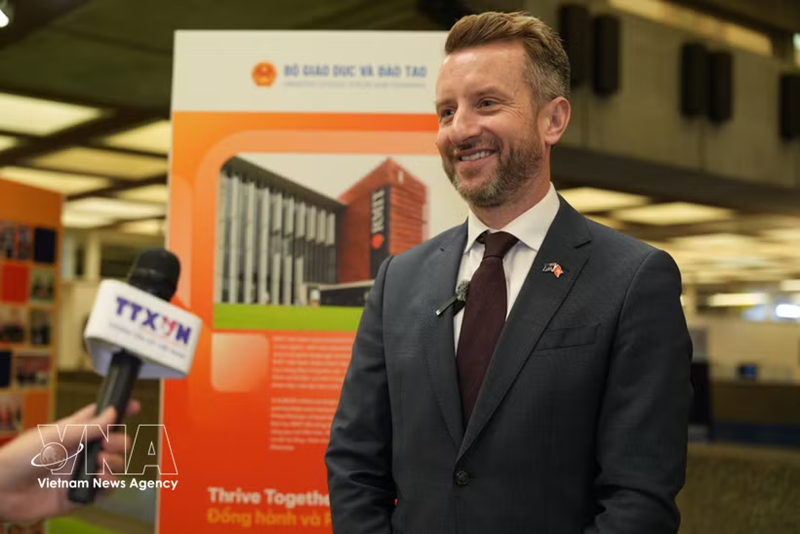
Layton Pike, Advisory Board Member of the Australia Vietnam Policy Institute |
Speaking to Viet Nam News Agency correspondents in Sydney on the sidelines of the forum, Vietnamese Minister of Education and Training Hoang Minh Son said a new feature of this year’s TechConnect is that, for the first time, science and technology, innovation, education and training, and investment are brought together within a single framework.
According to the minister, for many years, Viet Nam–Australia education cooperation has mainly been known for two areas: Australia’s support for Viet Nam’s training efforts, particularly vocational education, and the large number of Vietnamese students studying in Australia.
Son said the partnership is set to enter a new phase, towards greater equality and stronger links between the development of high-quality human resources in key sectors and science, technology and innovation.
With this approach, collaboration between educational institutions in the two countries would go beyond just student exchanges and joint training programs. Universities, research institutes, and businesses could team up throughout the entire process, from training talent and conducting research to developing and commercializing technology. This direction also aligns with Viet Nam’s current need for skilled professionals in areas like artificial intelligence (AI), semiconductors, quantum technology, clean energy, medical technology, and digital transformation.
Luke Sheehy, CEO of Universities Australia, said education has long played a central role in economic relations and people-to-people exchanges between the two countries. According to him, 30 of the association’s 38 member universities currently have cooperation agreements with Vietnamese educational institutions. Australian universities have provided education services in Viet Nam for more than two decades, while thousands of Vietnamese students have chosen Australia as their study destination.
Notably, Australian universities currently have more than 200 cooperation agreements with Vietnamese institutions across a range of fields. Sheehy said education plays an important role in helping the two countries adapt to technological transformation, build a clean-energy future, and equip workers with the skills needed to seize future opportunities.
At the exhibition held on the sidelines of the forum, nearly 20 booths featuring Vietnamese and Australian universities, research institutes, and businesses showcased a range of new technologies. AI is being applied in fields ranging from agriculture and education to healthcare and new materials. The products demonstrated how the demand for technology-trained personnel is becoming increasingly closely linked to research activities and businesses’ practical needs.
Layton Pike, Advisory Board Member of the Australia Viet Nam Policy Institute (AVPI), said people-to-people ties form the foundation of bilateral relations, with education being one of the most direct channels for building such connections.
Jane Tran, General Manager of TET Education Group, said education cooperation between the two countries was shifting from a model of support and technology transfer towards co-creation and co-development.
She said that rather than simply transferring existing technologies or training programs, the two sides could jointly develop training and research programs. Through such cooperation, research capacity and professional expertise could be shared directly between their academic teams.
Source: VNA