This was a common message highlighted by many New Zealand media outlets and observers in their coverage of General Secretary of the Communist Party of Viet Nam Central Committee and President To Lam’s state visit to New Zealand from August 12 to 14.
    |
 |
|
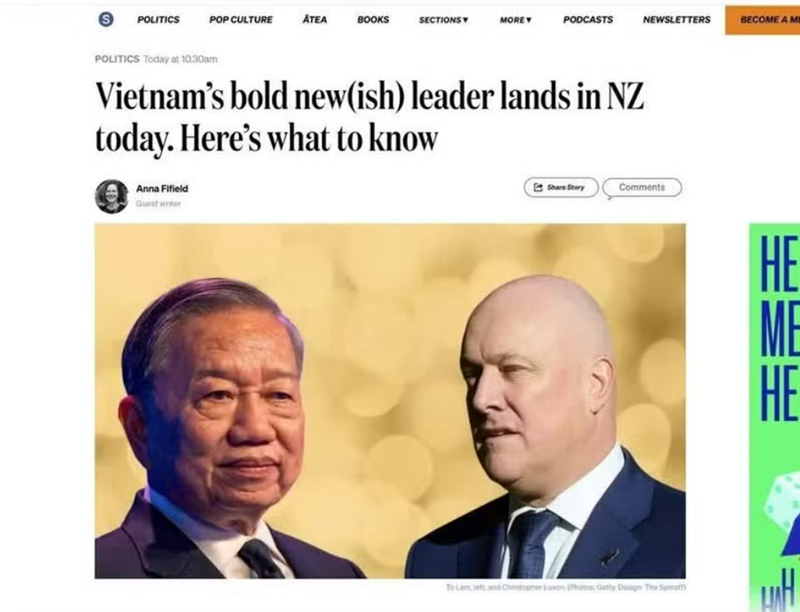
The analysis on General Secretary of the Communist Party of Viet Nam Central Committee and President To Lam’s state visit to New Zealand published on The Spinoff (Screenshot photo) |
The visit comes shortly after the two countries elevated their relationship to a Comprehensive Strategic Partnership in 2025, the highest-level framework in Viet Nam’s relations with foreign partners. The move reflects the strategic trust and shared vision between the two countries.
Stuff reported that the trip is the first state visit by a Vietnamese head of state to New Zealand in nearly two decades. It quoted Prime Minister Christopher Luxon as saying Viet Nam is becoming an increasingly important partner for New Zealand, amid the Southeast Asian country’s fast economic growth and strong expansion in bilateral trade.
Official figures cited by New Zealand media show two-way trade reached 3.41 billion NZD (about 2 billion USD) in the year to March 2026, up 72% over five years. PM Luxon stressed the need to maintain momentum in areas of mutual strength, including food and agriculture, education, tourism, technology, aviation and investment, noting that closer engagement with Viet Nam directly contributes to New Zealand’s prosperity and security.
From a strategic perspective, an August 9 analysis published by the Asia Media Center of the Asia New Zealand Foundation said the visit puts a spotlight on one of the fastest-expanding relationships in New Zealand's Asia portfolio. With a population of more than 100 million and impressive economic growth, Viet Nam has emerged as one of the region’s leading economic bright spots.
“For New Zealand, the visit is as much about positioning as it is about trade figures. Viet Nam sits inside ASEAN, APEC and the CPTPP, giving Wellington a partner with genuine multilateral reach at a moment when New Zealand is trying to diversify its economic relationships across the Indo-Pacific rather than lean further on any single major power,” wrote the analysis, adding that the elevation of bilateral ties to a Comprehensive Strategic Partnership reflects the practical need to broaden cooperation, from smart agriculture, education and climate change response to the development of a highly skilled workforce.
Meanwhile, The Spinoff published an in-depth analysis on August 12, describing the visit as a strategic step by both countries to diversify their partnerships in an increasingly uncertain world. It highlighted the achievements of Viet Nam’s Doi Moi (Renewal) process, which has transformed the country from a poor nation into a dynamic middle-income economy within a generation, as well as its ambition to become a developed, high-income country by 2045.
The Spinoff also pointed to strong complementarities between Viet Nam’s focus on science and technology as a key growth driver and New Zealand’s strengths in research, education and high-tech agriculture. With a market of more than 100 million people, a growing middle class and relatively few trade barriers, Viet Nam is increasingly viewed as a market with significant export growth potential for New Zealand.
The New Zealand Government has likewise expressed high expectations for the next stage of bilateral relations. In a statement on August 6, PM Luxon described Viet Nam as one of Asia’s fastest-growing economies and an increasingly important partner, expressing his anticipation of welcoming the top Vietnamese leader and discussing the “next phase” of bilateral ties.
Source: VNA