The law is expected to facilitate the transformation of IP rights into transferable and mortgageable assets, opening up new growth opportunities for startups and businesses seeking to leverage innovation for sustainable development.
Human resource bottlenecks
IP valuation plays a critical role in converting creative ideas into tangible economic value. It enables businesses to determine asset worth for transactions such as licensing, mergers and acquisitions (M&A), or using IP as collateral for loans. Accurate valuation not only supports commercialization but also helps firms expand market access, attract investment, and scale up their operations.
    |
 |
|
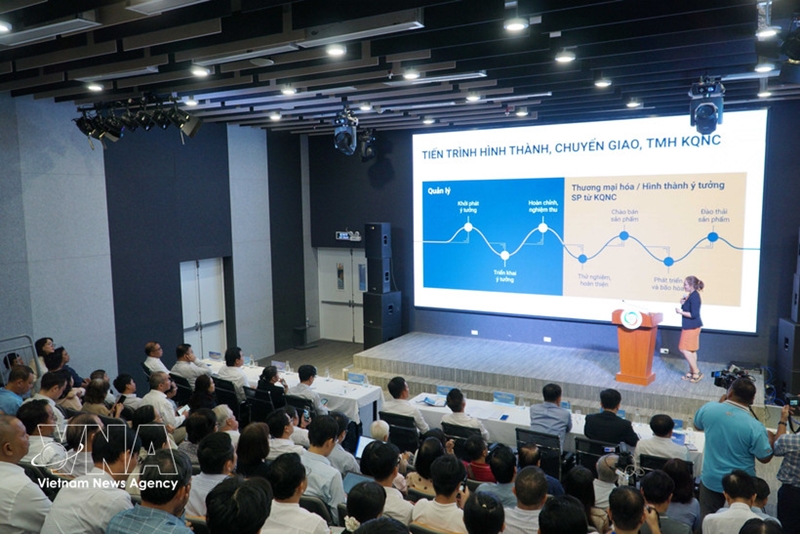
On March 13, 2026, the Ho Chi Minh City Department of Science and Technology holds a conference to launch a pilot scheme on policies designed to promote the commercialization and rapid application of research outcomes and intellectual property generated from the state budget into production and business activities. |
However, experts say a shortage of qualified IP valuation professionals remains a major constraint.
According to Tran Le Hong, Deputy General Director of the Intellectual Property Office (IPO) of Vietnam under the Ministry of Science and Technology, while the legal corridor is gradually completed, the lack of skilled valuators, professional intermediary organizations, reliable benchmarking databases, and unified valuation standards continues to limit the ability of enterprises, especially startups, to capitalize on their IP assets.
The International Valuation Standards Council (IVSC) outlines three common approaches to IP valuation: income-based, market-based, and cost-based methods. All require the involvement of IP valuation experts, including both individuals and specialized firms, to ensure objectivity and accuracy.
To address the human resource gap, Vietnam has stepped up cooperation with the World Intellectual Property Organization (WIPO), which plays a leading global role in developing IP valuation expertise. Through initiatives such as the WIPO Academy, training programs on IP management, commercialization, and valuation are being delivered to strengthen capacity in developing countries, including Vietnam.
The country is encouraged to draw on international experience and adopt valuation tools to build a professional workforce and enhance the overall effectiveness of IP commercialization.
Stronger exploitation of IP rights
Beyond human resources, legal and market risks remain key challenges. While IP certificates serve as legal proof of ownership, they may still be invalidated or infringed upon during transactions such as collateralization, potentially leading to financial losses. In addition, the lack of data connectivity between relevant agencies complicates asset verification, increasing transaction risks.
Vietnam also lacks risk mitigation instruments, such as insurance products for IP-backed loans or specialized credit guarantee mechanisms. Addressing these gaps is essential to fostering a more robust ecosystem for IP exploitation.
According to the IVSC, IP is a core business asset in the knowledge economy, supporting enterprises in expanding production and business activities and markets, and even addressing trade disputes. Effective IP management, from creation through commercialization, is therefore critical to maximizing economic value.
Luu Hoang Long, Director General of the IPO of Vietnam, noted that the amended law will cut processing time for industrial property applications by about 30%, with trademark examination reduced from nine months to five months. This is expected to accelerate the establishment and protection of IP rights, facilitate technology transfer, and strengthen businesses’ ability to safeguard key assets.
Long also stressed the need to build a national database on IP asset values and introduce transparent valuation standards to boost investor confidence.
He said that standardized toolkits and frameworks will help enterprises assess the competitiveness of their inventions and promote commercialization through licensing or transfer, contributing to the creative economic growth.
Source: VNA