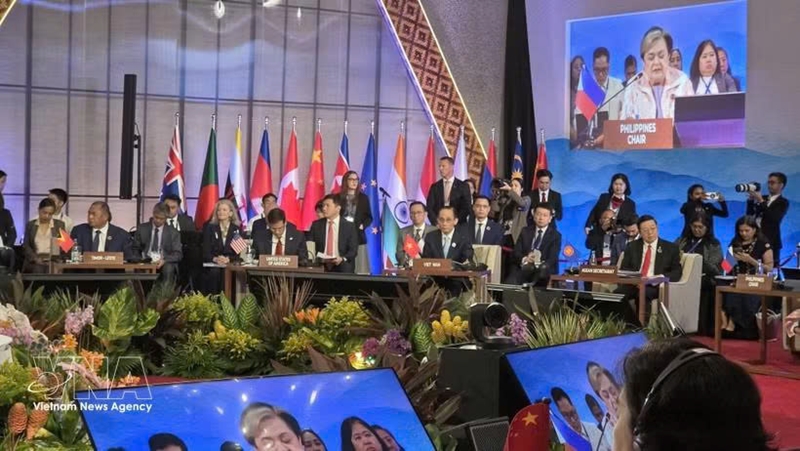
Addressing the meeting, Vietnamese Minister of Foreign Affairs Le Hoai Trung said that amid growing geopolitical and economic uncertainties, intensifying strategic competition and increasingly interconnected risks ranging from climate change and cybersecurity to supply chain disruptions, the ARF should shift from a model of reactive dialogue to one of proactive risk management by strengthening its capacity to anticipate and prevent the escalation of potential threats.
    |
 |
|
Vietnamese Minister of Foreign Affairs Le Hoai Trung attends the 33rd ASEAN Regional Forum in the Philippines on July 23, 2026. |
According to the minister, the ARF should continue adapting to evolving strategic realities while maintaining its role as an inclusive platform for dialogue in which major powers engage on the basis of respect for ASEAN's centrality. He stressed that the forum should also make more substantive contributions to the peaceful settlement of disputes in accordance with international law.
At the discussion, Trung outlined Vietnam's position, calling on all parties to exercise restraint, avoid further escalation of tensions in the Middle East, and ensure the safe and uninterrupted passage of vessels and aircraft through the Strait of Hormuz. He also expressed support for continued dialogue and diplomacy in pursuit of lasting peace and stability on the Korean Peninsula.
The minister affirmed that ASEAN would continue working with China to fully and effectively implement the Declaration on the Conduct of Parties in the East Sea (DOC) and to conclude at an early date a substantive and effective Code of Conduct in the East Sea (COC) that is consistent with international law, particularly the 1982 United Nations Convention on the Law of the Sea (UNCLOS).
Participating ministers affirmed that since its establishment in 1994, the ARF has remained the region's principal political and security dialogue mechanism, playing an important role in promoting dialogue, confidence-building and preventive diplomacy. They noted that the implementation of the Hanoi Plan of Action II (2020–2025) has achieved a high completion rate, particularly in priority areas such as maritime security, information and communications technology security, and disaster relief.
The ministers emphasized that the ARF should continue adapting to the current strategic environment by maintaining confidence-building measures as its foundation while advancing more practical preventive diplomacy.
The meeting also adopted the ARF inter-sessional year calendar of activities for 2026–2027 and noted ASEAN's consensus on admitting the UK as the 28th member of the ARF.
On the regional and international situation, the ministers expressed concern over increasingly complex challenges, including food security, energy security, climate change, cybersecurity and issues arising from emerging technologies.
They reaffirmed the importance of maintaining peace, security, stability, safety, and freedom of navigation and aviation in the East Sea (aka South China Sea); and of resolving disputes peacefully in accordance with international law, particularly the 1982 UNCLOS.
The meeting underscored the need for the full and effective implementation of the DOC and the early conclusion of a substantive and effective COC.
Participants also exchanged views on developments in the Middle East and on the Korean Peninsula, calling on all parties to exercise restraint, avoid escalating tensions, and pursue dialogue and diplomacy in the interests of lasting peace.
Source: VNA