The happiest are the students. Tran Thi Ngoc Diem, an eighth-grade student in Class 8A1, and Le Phu Quy, an eighth-grade student in Class 8A4, at Kien Moc Primary and Secondary Boarding School in Kien Moc commune, Lang Son province, no longer have to watch the construction site from outside. They now study in new classrooms, eat in a new dining hall and play in a new schoolyard. Diem smiled and said, “This really is a five-star school.”
    |
 |
|
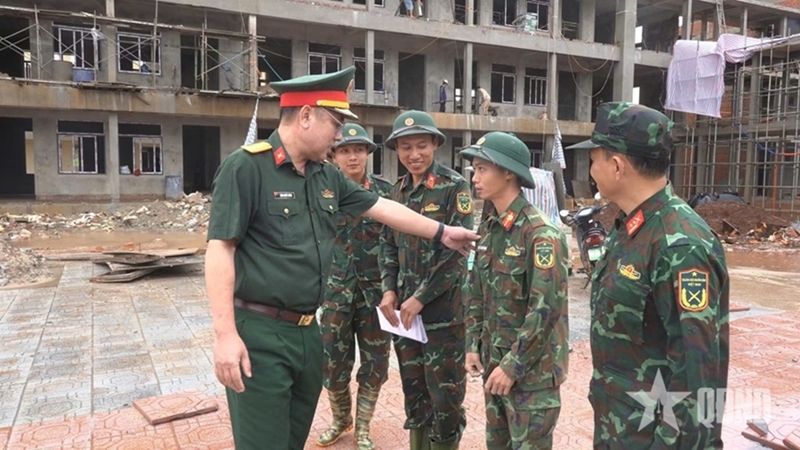
Leader of Division 968 visits and encourages officers and soldiers participating in the construction of Huong Phung Primary and Secondary Boarding School. |
Teacher Tran Thi Hong was equally pleased. Previously, because she lived far from the school, she had to rent a place to ease the burden of commuting. The school’s new official housing for teachers who live far away will allow her and her colleagues to stay closer to their students and feel more secure in their work.
Teacher Vi Tien Thanh said the new facilities provide teachers with more space to organize educational activities and give students better conditions for studying and training. He believes the schools will help improve education quality in border areas, giving local children greater opportunities to study and grow up in their homeland.
For Pham Thi Quynh Nhu, an eighth-grade student at Khuat Xa Primary and Secondary Boarding School in Khuat Xa commune, the new school means better-equipped classrooms, a library and a playground. She sees the modern facilities not only as a better learning environment but also as motivation to love her school and classes and work harder for the future.
The story of Hoang Bao Lam, an eighth-grade student from Na Cang village, Khuat Xa commune, highlights the importance of boarding schools for disadvantaged families. Lam had to leave school during the second semester of the 2024-2025 school year to accompany his father to work. His family’s difficult circumstances and the distance to school eventually disrupted his education.
His grandfather, Hoang Van Chu, hopes Lam can return to school. “With a boarding school, our family will try to send him back to school,” he said. For families like Lam’s, boarding schools can provide more than classrooms, accommodation and meals. They can help keep children connected to education and bring those who have left school back to the classroom.
Sr. Col. Nguyen Cong Khue, Political Commissar of the Lang Son Provincial Military Command, said border boarding schools in Lang Son province and across the country will contribute to narrowing the educational gap between mountainous and lowland areas. Spacious, solid schools with adequate facilities for teaching, learning and daily activities provide an important foundation for students to improve their academic performance and develop comprehensively.
“When education quality improves, they will be able to make more practical and effective contributions to building and protecting their homeland and the national border,” Col. Khue said.
Sr. Col. Dang Quyet Thang, Political Commissar of Division 968 under Military Region 4, said the Huong Phung Primary and Secondary Boarding School in Huong Phung commune, Quang Tri province, which his unit helped construct, along with other border boarding schools, vividly demonstrates the Party and State’s care for the lives and future of border residents.
“When their children have better conditions for studying and living, local people will have greater confidence in the Party’s leadership and the State’s administration. From there, they will actively participate in building a stable and developed locality while safeguarding national sovereignty and border security,” he said.
The boarding schools have now begun the new school year, while officers and soldiers who helped build them have returned to their units. Yet their discipline, responsibility and affection for local communities have left a lasting impression.
Tran Dang Khoa, an employee of Nga Phong One-Member Co., Ltd. and deputy head of construction site at Khuat Xa Primary and Secondary Boarding School, said he was impressed by the officers and soldiers of Battalion 1, Regiment 123, under the Lang Son Provincial Military Command. He praised their agility, resourcefulness and sense of responsibility, as well as the polite and sincere way the young soldiers communicated and their orderly, clean living arrangements despite staying in temporary quarters.
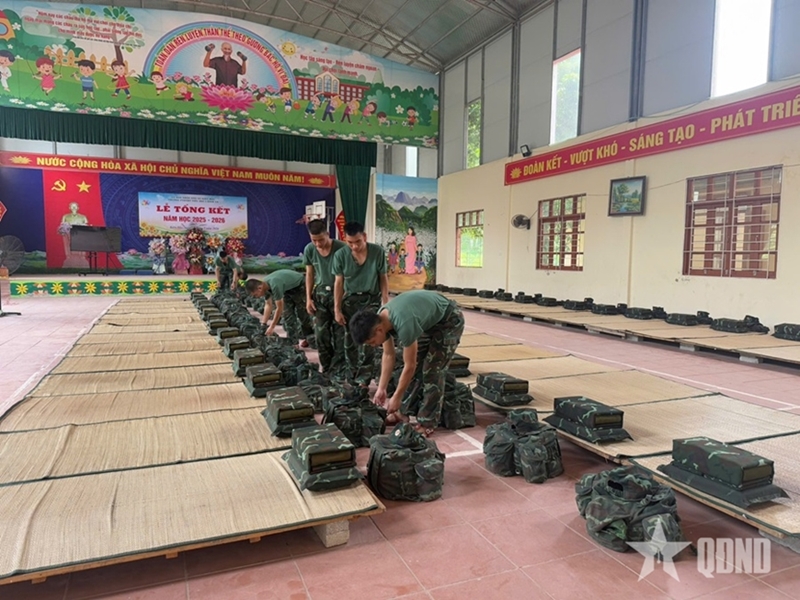
At their accommodation at the Hop Thanh Village Cultural House in Khuat Xa commune, near the construction site, the soldiers maintained the same discipline. Despite heavy rain and muddy conditions outside, the floor was kept clean. Clothes were hung properly, shoes were washed and neatly arranged, and backpacks, blankets and mosquito nets were lined up in accordance with military housekeeping and hygiene regulations.
A similar scene could be seen at the Binh Xa I Semi-boarding Primary School for Ethnic Minority Students in Kien Moc commune, where officers and soldiers of Battalion 1, Regiment 123, stayed while helping build Kien Moc Primary and Secondary Boarding School. The school’s assembly hall served as their sleeping area, with wooden platforms arranged in two rows and personal belongings neatly organized. After their lunch break, the soldiers cleaned the schoolyard before returning to the construction site. They also grew vegetables and raised several ducks in a small garden behind the administration building to supplement their meals.
Be Thi Lai, a resident of Ban Moi village, Kien Moc commune, said the soldiers were “very well-behaved” and kept their living area clean and neat. Local residents sometimes brought them vegetables, cool water or fruit to help supplement their meals.
|
|
 |
|
The living and dining area of the officers and soldiers of Regiment 123 of the Lang Son Provincial Military Command participating in the construction of Kien Moc Primary and Secondary Boarding School is always kept neat and orderly. |
These modest gifts reflect the sincere appreciation of local people for officers and soldiers who joined them in a race against time to build schools along the border.
Above all, the school bells now ring each morning, the brightly lit classrooms and the sound of children at the boarding facilities are the clearest signs of the joint efforts of soldiers and local communities. These schools not only open another door to knowledge but also strengthen people’s faith in a better future for communities living along the Fatherland’s frontier.
Translated by Tran Hoai