Behind the achievement were days and nights of intensive construction, with soldiers, workers, contractors, and local residents overcoming difficult terrain and unpredictable weather. Their efforts left a lasting mark of solidarity and shared commitment between the military and local communities.
Building large-scale schools with classrooms, functional facilities, and accommodations in just over nine months was a major challenge, particularly in remote mountainous border areas. For children and local residents awaiting the new schools, however, those months seemed like a long wait.
At Kien Moc Primary and Secondary Inter-Level Boarding School in Kien Moc commune, Lang Son province, the intense heat in late August did little to slow the construction. Hundreds of soldiers, workers, and local residents worked across the site, building, plastering, painting, transporting materials, and installing equipment. The sounds of vehicles and machinery echoed through the surrounding mountains, while the ochre-yellow school buildings stood out against the green hills.
    |
 |
|
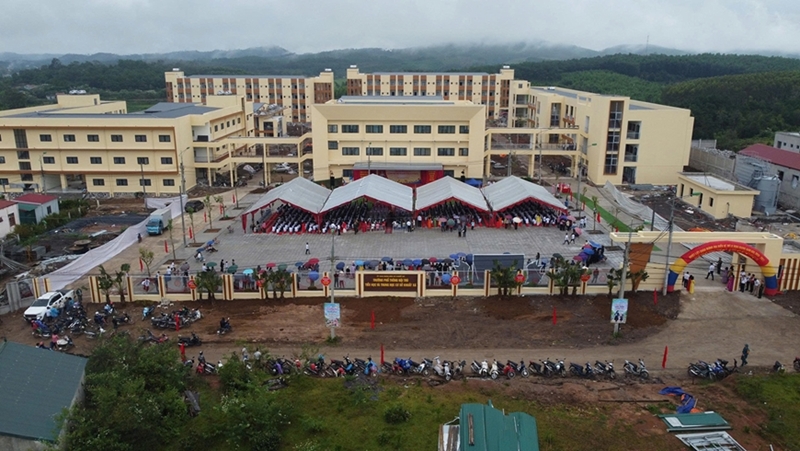
Khuat Xa Primary and Secondary Inter-Level Boarding School in Khuat Xa commune on the opening day of the 2026-2027 school year |
Pham Hung Viet, an official of Engineering and Construction Investment Joint Stock Company 29, under Corporation 319 of the Ministry of National Defense, was overseeing a school construction project for the first time. The tight schedule, difficult terrain, labor shortages, and unfavorable weather required him to remain at the site almost around the clock.
“We initially had to lower the site by about 30 meters, mainly through weathered rock, which was quite difficult. We adopted a rolling construction approach and adjusted our work according to the weather. On dry days, we focused on exterior work; when it rained, we moved indoors. We continuously worked overtime, and at times had to encourage workers to work at night. In general, neither the people nor the project had much time to rest,” Viet said.
A similar race against time was underway at Khuat Xa Primary and Secondary Inter-Level Boarding School in Khuat Xa commune, Lang Son province. Contractors mobilized all available resources to complete their contracted work so the school could begin trial operations on August 26.
Tran Dang Khoa, deputy site manager at Nga Phong One-member Co., Ltd., was constantly coordinating work by phone. “The project has been a major challenge because of the large workload and short timeframe, while the border area has complex terrain, incomplete infrastructure, and unpredictable weather. To meet the schedule, everything from site preparation and personnel deployment to material supplies had to be carefully planned,” Khoa said.
Military personnel also played a major role in keeping the projects on schedule. The officers and soldiers of Regiment 123 under the Lang Son Provincial Military Command helped construct Kien Moc and Khuat Xa schools, while soldiers from Regiment 19 of Division 968 under Military Region 4 helped build Huong Phung Primary and Secondary Inter-Level Boarding School in Huong Phung commune, Quang Tri province.
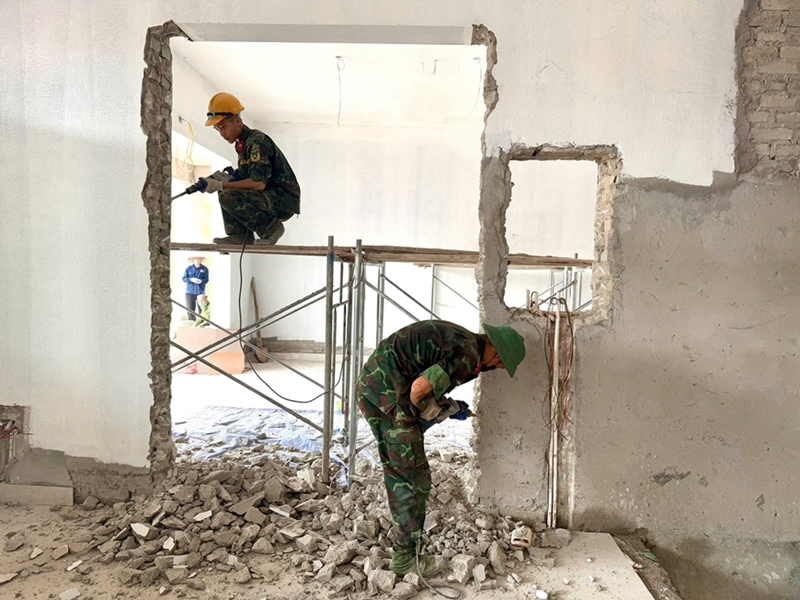
Soldiers transported materials and equipment, installed electrical systems, drilled and cut concrete, leveled cement floors, and operated construction machinery. Officers at all levels remained at the sites, inspecting work, ensuring safety, and adjusting personnel and equipment to match actual conditions.
For construction managers, the tight deadlines made each day seem too short. For border residents, especially children eagerly awaiting their new schools, time seemed to move much more slowly.
That anticipation was evident in eighth-grade students Tran Thi Ngoc Diem and Le Phu Quy of Kien Moc Primary and Secondary Inter-Level Boarding School. Their houses are about 6 kilometers from the school, and they went there by bicycle almost every day to see how the construction was progressing. Even when the buildings were still unfinished, they were already imagining where the classrooms, dining hall, soccer field, badminton court, and swimming pool would be. They had never imagined they would one day study and live at a school with such comprehensive facilities.
For Hoang Bao Nguyen, an eighth-grade student from Po Hang village, Kien Moc commune, the new school will end the daily hardship of leaving home early to travel nearly 10 kilometers to Binh Xa Secondary School. More importantly, he will be able to live, eat, and study at school instead of making the long journey every day.
Teacher Vi Tien Thanh, former vice principal of Binh Xa Secondary School and now a teacher at Kien Moc Primary and Secondary Inter-Level Boarding School, understands those difficulties well. After years working in Lang Son’s border areas, he has seen the challenges faced by students and their families. Parents are often occupied with farming, earning a living, and household responsibilities and cannot always take their children to school. Some students therefore have to travel long distances on their own, with some villages located as far as 15 kilometers from school.
|
|
 |
|
Officers and soldiers of Regiment 123 under the Lang Son Provincial Military Command carry out finishing work inside Kien Moc Primary and Secondary Inter-Level Boarding School. |
“When the boarding school begins operating, students who live far away will be able to eat and stay at school, with practical support policies and better conditions for learning and daily life. For a long time, we have hoped for a school with enough classrooms, functional rooms, and an environment where students can truly study and play," Thanh said.
Hoang Thi Kim Hoat, Secretary of the Party Committee and Chairwoman of the People’s Council of Kien Moc commune, said the new school would also ease the burden on families. “The locality has a very high proportion of students who live far away. When the new school begins operating, students will face fewer hardships on their educational journey, and parents will also feel more reassured,” she said.
The stories of residents, students, teachers, and local officials reveal the depth of their anticipation and excitement for the new schools. Their long wait was ultimately a wait for shorter journeys to school and better opportunities for the children of the border areas.
(To be continued)
Translated by Tran Hoai