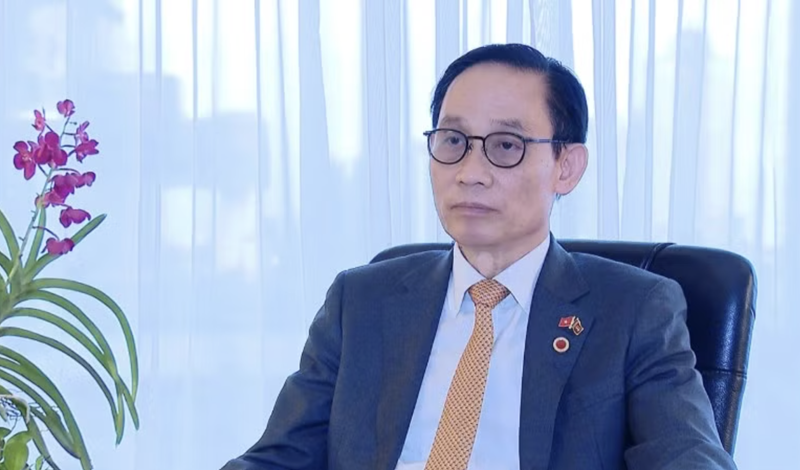
Speaking to the press, Minister Trung described the visits as particularly important and historic, taking place at a meaningful moment as Vietnam and India mark the 10th anniversary of their Comprehensive Strategic Partnership and just one month after the top leader of Vietnam assumed his new position. For Sri Lanka, this was the highest-level visit by a Vietnamese leader since the two countries established diplomatic relations.
Substantial outcomes were recorded. Vietnam and India agreed to elevate ties to an Enhanced Comprehensive Strategic Partnership, while Vietnam and Sri Lanka upgraded their relations to a Comprehensive Partnership, creating new political frameworks to strengthen mutual trust and understanding.
    |
 |
|
Minister of Foreign Affairs Le Hoai Trung |
More than 50 cooperation documents signed with India and 11 with Sri Lanka reflected the strong commitment of all sides and are expected to provide important momentum for bilateral relations. Vietnamese, Indian, and Sri Lankan leaders also discussed measures to strengthen ties between the Communist Party of Vietnam and the two countries’ ruling parties, parliamentary cooperation and people-to-people diplomacy.
According to the minister, strategic orientations aimed at removing bottlenecks, expanding markets, strengthening economic connectivity, investment, infrastructure, science and technology, innovation and supply chains received particular attention from the leaders, accompanied by highly specific cooperation proposals. The sides also affirmed their determination to further deepen defense and security cooperation while identifying the economy and science and technology as new pillars of cooperation, alongside practical programs and plans to enhance education and training cooperation.
With India, the outcomes of the visit have elevated bilateral relations to a new height, opening up significant potential for cooperation in security and defense, trade and investment, science and technology, education and training, culture and people-to-people exchanges, promising to usher bilateral ties into a “golden era”.
Regarding Sri Lanka, both sides committed to further strengthening friendship and cooperation, building a high level of political trust and expanding collaboration in a comprehensive and substantive manner across all sectors. They also agreed to increase bilateral trade turnover to five times its current level within the next few years. Sri Lanka’s recent economic stabilization has also created new opportunities in trade, minerals, manufacturing, seaports and other sectors.
Amid increasing global uncertainties and volatility, Party General Secretary and State President To Lam and leaders of the two countries agreed on the need to strengthen close coordination and mutual support on the basis of respect for international law and the United Nations Charter, while promoting multilateralism.
Minister Trung stressed that the visits represented a concrete implementation of Vietnam’s foreign policy of independence, self-reliance, peace, friendship, cooperation and development, as well as diversification and multilateralization of external relations, including efforts to deepen ties with traditional friends and strengthen relations with major and important partners in the Asia-Pacific region.
The foreign minister noted that in the coming period Vietnam will work closely with India and Sri Lanka to effectively implement high-level agreements and signed documents, while proactively removing bottlenecks and barriers to cooperation in order to achieve more tangible and measurable results.
Cooperation with India will focus on economic connectivity, trade, investment, strategic infrastructure development, logistics and supply chains, science and technology, innovation, culture and tourism. With Sri Lanka, priority areas include infrastructure, telecommunications, high-tech agriculture, fisheries, green transition and tourism, particularly spiritual tourism.
Source: VNA