Having worked with Vietnamese universities, research institutes and cultural partners for more than a decade, Marwah said she has developed a special affection for the country’s first university, established under the Ly Dynasty (1009–1225).
Talking to a Viet Nam News Agency (VNA) correspondent in New Delhi, she highlighted the site's enduring significance, saying it reflects Viet Nam's rich academic heritage, tradition of respecting teachers and commitment to knowledge.
    |
 |
|
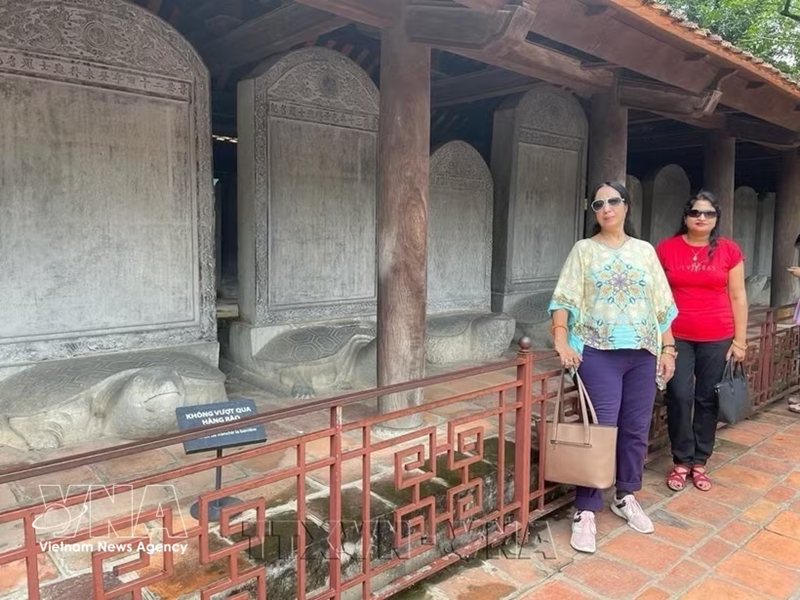
Professor Reena Marwah (left) poses for a photo beside the doctoral laureates’ steles at the Temple of Literature – Imperial Academy, a symbol of Viet Nam’s longstanding reverence for knowledge. |
She noted that the establishment of the country's first university almost 1,000 years ago demonstrated the deep roots of Confucian values in Vietnamese society, including respect for elders, social equity and ethical conduct. These values, she said, have helped lay the foundation for sustainable social development.
Having visited the site during her trips to Ha Noi, Marwah said she is particularly impressed by its role in preserving the country's scholarly traditions and inspiring younger generations.
She recalled being moved by the sight of Vietnamese students visiting the Temple of Literature – Imperial Academy to offer incense and pray before important examinations, a practice she said closely resembles traditions in India.
In India, young people often pray to Saraswati, the Hindu goddess of knowledge, music and the arts, for academic success. The similarities, she observed, reflect the importance both cultures attach to education and spiritual values.
Beyond its historical and architectural significance, the Temple of Literature – Imperial Academy also demonstrates how Viet Nam's intellectual heritage could strengthen its international standing, she said.
Marwah considered the country's tradition of learning an important pillar of its soft power, alongside its Buddhist heritage and the legacies of the Champa and Oc Eo civilizations.
She noted that Viet Nam's appeal to the world extends beyond its landscapes, cuisine and traditional costumes to encompass its educational traditions, social values and respect for knowledge and ethics.
These shared cultural values, she said, offer fertile ground for stronger exchanges and closer connections between Viet Nam and other countries, particularly India.
Source: VNA