If fostering a strong system of human values lays the foundation for a city's endogenous strength, the next challenge is ensuring those values are not confined to policy documents or slogans but become an integral part of everyday life.
Experience in Ho Chi Minh City suggests that for culture to truly take root within the community, people must be given spaces with which to engage, experience, discuss and create culture.
This is also a key pathway for transforming cultural assets into a development resource, in line with the spirit of Resolution No.80-NQ/TW.
From preservation to creating living cultural spaces
A value system can only flourish when there is an environment in which it can be practiced.
As public demand for cultural experiences becomes increasingly diverse and digital technologies continue to reshape daily life, cultural activities are evolving beyond traditional exhibitions and performances towards greater interaction, participation and immersive experiences.
    |
 |
|
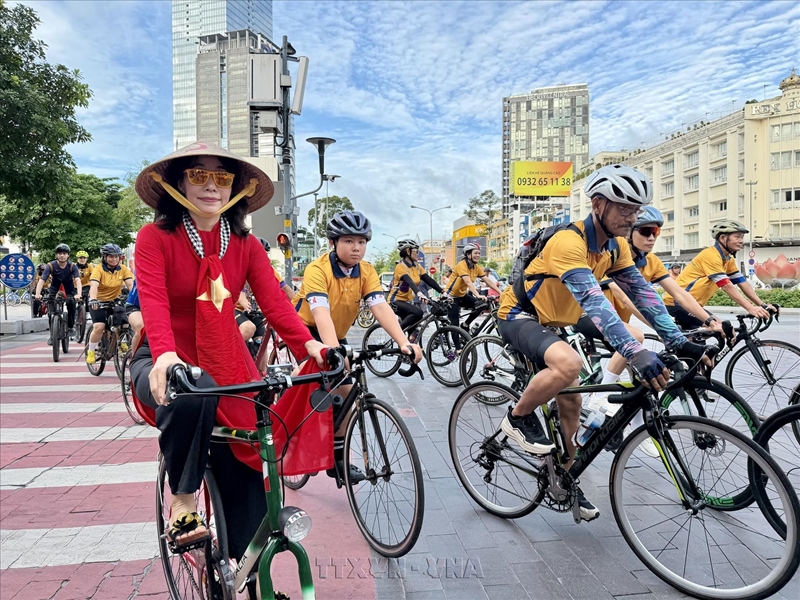
Residents of Ho Chi Minh City take part in a traditional attire event celebrating Viet Nam’s National Day on September 2. |
This requires the creation of open cultural spaces where residents are not merely audiences, but active contributors to the creation and dissemination of cultural values.
This is also one of the key directions outlined in the implementation of Resolution No.80-NQ/TW.
While preserving and promoting cultural heritage has long been a priority, the new phase of development calls for continued innovation in the operation of cultural institutions, bringing culture closer to people's everyday lives while strengthening its role as a driver of sustainable development.
The transformation is already becoming increasingly evident across Ho Chi Minh City, with the city's Book Street standing out as one of the most successful examples.
Over the past decade, Ho Chi Minh City’s Book Street has evolved from a venue for book sales into a vibrant community cultural space hosting author talks, seminars, exhibitions, children's activities and reading promotion events.
To date, nearly seven million books have been distributed through the venue, while more than 3,000 cultural, educational and artistic events have been organized, firmly establishing it as one of the city's cultural landmarks.
According to Phan Xuan Thuy, Vice Chairman of the Party Central Committee's Commission for Publicity, Ho Chi Minh City’s Book Street represents a successful model of a community-oriented cultural institution and offers valuable experience for other localities seeking to develop public reading spaces.
Book Street is not the only example.
Several museums across the city are also embracing new approaches by expanding heritage education programes, interactive exhibitions and digital applications, moving beyond the conventional role of displaying artefacts.
The "Touching Heritage – Urban Memories" program illustrates this shift by combining historical narratives and urban memories with digital technology and modern communications, allowing visitors, particularly young people, to engage with heritage through experience rather than passive observation.
According to Nguyen Ngoc Hoi, Deputy Director of Ho Chi Minh City’s Department of Culture and Sports, the program demonstrates how heritage can be connected with technology, and tradition with modernity, creating more opportunities for residents to discover the city's cultural and historical values within the places where they live.
Ho Chi Minh City is currently home to an extensive cultural heritage system, comprising 314 recognised historical and cultural relics, 23 national treasures, 23 museums and three elements of intangible cultural heritage inscribed by UNESCO.
The city is also finalizing its nomination dossier for the Cu Chi Tunnels to be considered for inscription as a World Heritage Site.
These assets represent not only invaluable resources for conservation but also an important foundation for developing cultural industries if harnessed effectively.
According to Nguyen Thi Hau, General Secretary of the Ho Chi Minh City Historical Science Association, many countries have shifted from traditional conservation models towards data-driven heritage governance.
Whereas museums once focused primarily on preservation, research and exhibitions, data has now become the foundation for connection, knowledge sharing and value creation.
Heritage is therefore no longer simply something to be protected; it has become a resource for education, tourism and the creative industries.
Digital transformation, she said, is not merely a technical solution but a means of expanding the living space of heritage in contemporary society.
Nguyen Thi Phuong Thao, member of the Party Committee of Vung Tau ward, believes that preserving traditional customs and values today should not mean maintaining them unchanged, but rather inheriting and adapting them to contemporary life.
Alongside safeguarding the qualities that have long defined the people of southern Vietnam, such as patriotism, compassion, generosity, openness and a strong sense of solidarity, the city should continue nurturing new values such as dynamism, creativity, discipline, responsibility and global integration, she said.
Digital technology is opening new opportunities for cultural values to be communicated through contemporary forms of expression.
Digitizing heritage, producing cultural content for digital platforms and combining traditional arts with modern creative media can help bring heritage closer to younger generations while preserving its essential values.
From an artistic perspective, Ngo Pham Hanh Thuy, a People's Artist and master's degree holder, believes that the arts possess a unique ability to communicate cultural values because they speak directly to human emotions.
Lessons about history, traditions and ways of life, she said, often struggle to resonate when conveyed solely through information.
However, when expressed through theatre, cinema, music and other art forms, these values can touch audiences emotionally, helping shape both public awareness and behavior.
These developments suggest that what the public needs is not simply a greater number of cultural activities, but cultural spaces capable of forging meaningful connections between culture and everyday life.
Source: VNA