Bringing Vietnamese culture closer to visitors
Located on Lac Long Quan street in Dien Ban Dong ward, The Hangart handicraft art space covers 3,000 sq.m and recreates 12 traditional Vietnamese craft villages. It regularly hosts 16 handicraft workshops, allowing visitors to experience a wide range of cultural activities, including making do paper, creating pottery inspired by Thanh Ha pottery village, practicing Kim Bong wood carving in Hoi An, hand embroidery, printing folk paintings, and dyeing fabrics with natural colors.
Visitors can also take part in activities associated with traditional Vietnamese life, such as making essential oils, herbal extracts, herbal soaps and traditional cakes. Each workshop is designed around hands-on experiences, enabling visitors not only to observe but also to create their own handicrafts with a personal touch.
    |
 |
|
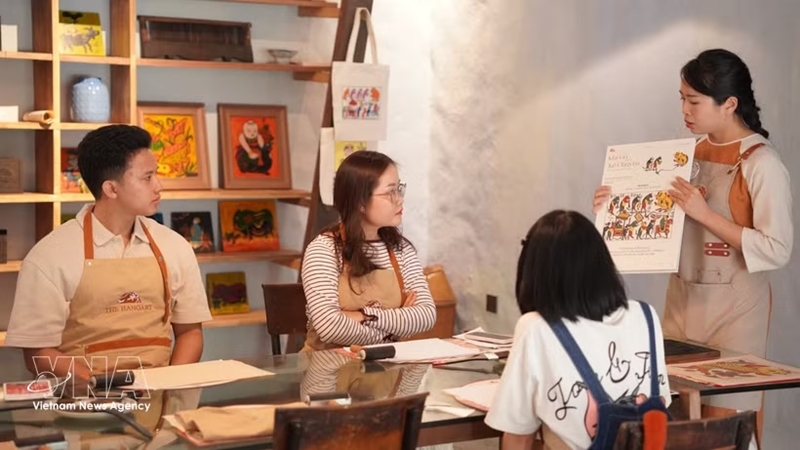
The Hangart regularly hosts 16 handicraft workshops, allowing visitors to experience a wide range of cultural activities. |
Phan Minh Toan, a resident of Da Nang, shared that he finds the process of making do paper captivating. Participating firsthand in the various stages of production lets visitors connect with culture through their own hands, he said, adding that such experiences give young people a chance to learn more about traditional heritage.
The space holds particular appeal for international visitors. Stepping into The Hangart is like entering a miniature complex of traditional craft villages, with a diverse range of handicraft activities. Each area offers a distinct glimpse into Vietnamese culture, enriching the overall journey of cultural discovery.
Kuntida Juntarawong, a Thai visitor experiencing The Hangart for the first time during her visit to Da Nang, said she was impressed by the venue. Its layout and displayed handicrafts gave her a sense of closeness to Vietnamese culture, particularly through hands-on activities such as making jewelry and lanterns.
The creative model stems from the dedication of young people seeking to bring traditional culture closer to the public and international visitors. Rather than presenting heritage through conventional methods, The Hangart incorporates cultural values into hands-on activities that resonate with contemporary life.
According to Kim Thao Linh, sales manager at The Hangart, international visitors currently account for more than 80% of its customers, mainly from Japan, China, Russia, the Philippines and Thailand. As travel preferences evolve, services incorporating traditional cultural elements are attracting growing interest. Visitors learn about the history of craft villages, make handicrafts themselves, and take their creations home as souvenirs of their journeys through Viet Nam.
A sustainable approach to preserving heritage
Linking heritage preservation with tourism development is opening up new opportunities for traditional craft villages. Through hands-on activities, cultural values can be preserved and shared more widely, while creating livelihoods and contributing to local socio-economic development.
The charm of The Hangart's model is in how it bridges visitors to Vietnamese culture, breaking through language and distance. By creating the products themselves, visitors not only learn about production techniques but also uncover the rich cultural stories behind each craft.
Amid the pace of modern life, the space adopts a slower approach, using hands-on experiences to bridge the gap between heritage and the public. Artisan Tran Thi Thu Trang, who has spent more than 20 years practicing silk embroidery, continues to work meticulously with each thread while guiding visitors through every stitch.
Trang said she was happy to practice her craft, pass on her skills to young people and promote Vietnamese culture to domestic and international visitors. When visitors embroider silk, bags or conical hats themselves and take their creations home as souvenirs, they also help raise the profile of traditional handicrafts.
When young people find new ways to retell old stories, traditional values gain greater opportunities to endure and become a natural part of contemporary life. The handicraft workshop model in Da Nang not only enriches the local tourism ecosystem but also promotes the image of Viet Nam as a culturally rich, dynamic and creative country to international audiences.
Nguyen Thi Thuy Ha, director and co-founder of The Hangart, said Viet Nam has many traditional craft villages with valuable historical and cultural stories. Incorporating these villages into tourism activities allows visitors to explore and learn about Vietnamese culture in a more accessible and engaging way.
Some traditional crafts now face the risk of fading away, including Sinh folk painting and Ma Chau silk weaving, which has a history spanning more than 300 years. In selecting crafts for its workshops, The Hangart prioritices those closely connected with everyday life, such as pottery, woodworking, hand embroidery, painting, handicraft production, decorative crafts, weaving and dyeing.
Finding ways to adapt these crafts to contemporary life is essential to preserving, promoting and spreading their value, thereby helping sustain the vitality of craft villages at risk of disappearing, Ha said.
Source: VNA