A symbol of Kinh Bac’s academic tradition
The temple was built during the Early Le Dynasty in the Thi Cau area of the former Kinh Bac region, and relocated to Phuc Son Mountain in 1893 under the reign of King Thanh Thai. It is dedicated to Confucius and prominent Confucian scholars, while honoring distinguished figures from Bac Ninh – Kinh Bac who made significant contributions to the country under Viet Nam’s feudal dynasties.
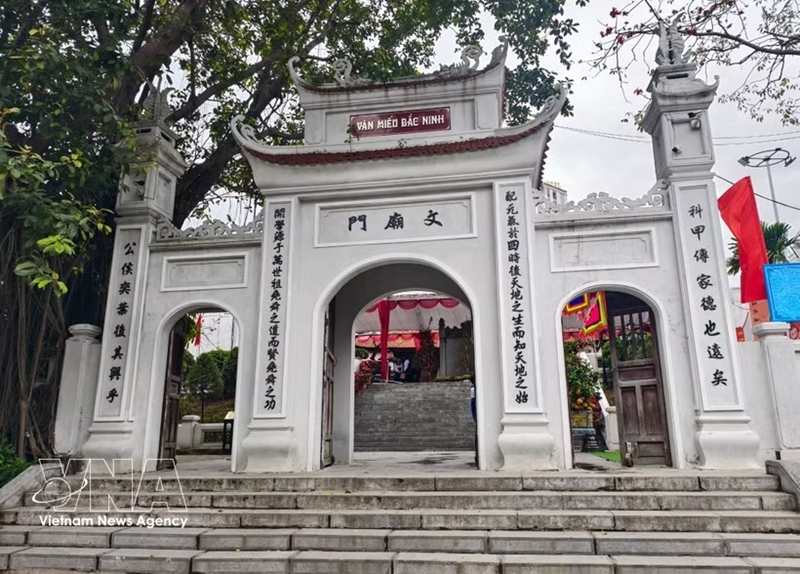
Following several restorations, the site has developed into an architectural complex comprising Tam Mon (three-entrance gate), Tien Te (front worship hall), Hau Duong (rear hall), Ta Vu (left pavilion), Huu Vu (right pavilion) and Tao Soan house, surrounded by a spacious garden with lush greenery.
    |
 |
|
The Bac Ninh Temple of Literature stands as a testament to the Kinh Bac region’s rich scholarly tradition. |
Nguyen Huu Chien of the municipal relic management board, said the temple’s most notable feature is a collection of 12 stone steles entitled “Kim bang luu phuong” (The golden list preserves fame), erected in 1889 under the reign of King Thanh Thai by education mandarin Do Trong Vi.
The steles record the full names, hometowns, examination years, academic degrees, and positions of successful candidates in the highest-level royal examinations from Kinh Bac across different dynasties. They are valuable historical sources of materials on Viet Nam’s examination system, local education and cultural traditions.
The collection was recognized as a national treasure in 2020, while the temple was classified as a national historical and cultural relic in 1988.
Chien said the site preserves both tangible heritage and the region’s longstanding respect for learning and teachers. The steles honor outstanding predecessors while encouraging younger generations to pursue knowledge, improve themselves and contribute to society.
Historical records show that nearly 3,000 people attained the highest academic degrees during Viet Nam’s feudal period, of whom 677 came from Bac Ninh – Kinh Bac, accounting for almost one-quarter of the total. This figure clearly reflects the tradition of valuing education and talent, which has been nurtured over many centuries.
Passing the traditional fondness for learning on to younger generations
The tradition continues to thrive among younger generations today, whose academic achievements reflect the legacy honored by the temple’s ancient steles.
School groups, particularly students who have excelled in national and international competitions, regularly visit the site to pay tribute to earlier generations of scholars and learn about their homeland’s academic heritage.
One such example is Nguyen Huu Tien Hung, a former student of Bac Ninh High School for the Gifted, who won a gold medal at the 2024 International Chemistry Olympiad with the highest score among members of Viet Nam’s team.
Hung recalled that before major examinations, students and teachers often visited the temple to pay tribute to distinguished scholars. The names engraved on the steles helped him better appreciate the region’s learning tradition and understand his responsibility to uphold it through academic efforts and personal development.
Beyond its historical significance, the temple now serves as a venue for educational activities organized by agencies, schools, families and mass organizations. Incense-offering ceremonies, achievement-reporting events and scholarship presentations help connect historical traditions with contemporary education, fostering pride and a sense of responsibility among young people.
Nguyen Van Luyen, Deputy Director of the municipal relic management board, said the board has assigned staff to work regularly at the site to assist visitors and preserve the heritage.
The city is also incorporating the temple into cultural, educational and tourism activities. In 2025, the inauguration of the President Ho Chi Minh Temple and the implementation of a project to build technical infrastructure and auxiliary facilities for the Bac Ninh Temple of Literature Park helped expand the cultural space and improve the site's landscape and visitor appeal.
Through these activities, the temple has become an important venue for educating the public about the traditions of learning, patriotism, and revolutionary commitment, encouraging generations of Bac Ninh residents to study, work and contribute to local development.
Source: VNA