The articles underscored a set of strategic solutions rooted in renewed thinking, designed to steer the country into an era of peace, independence, democracy, prosperity, civilization, and happiness under continued socialist orientation.
    |
 |
|
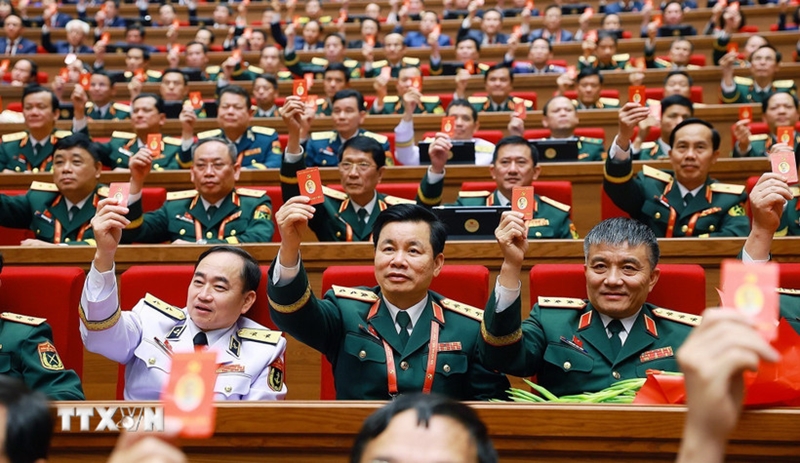
Delegates vote to approve the Resolution of the 14th National Party Congress |
In its January 30 commentary, Koh Santepheap described the 14th Congress as a resounding success that captured widespread public attention with the theme of “Solidarity – Democracy – Discipline – Breakthrough – Development.” The newspaper highlighted the Congress’s focus on strategic autonomy, resilience, and confidence as Vietnam enters a new era.
Koh Santepheap, one of Cambodia’s oldest publications, devoted significant space to General Secretary To Lam’s remarks at the January 23 press conference in Hanoi, as well as his responses to foreign journalists on the new features of the 14th Congress and Vietnam’s role in tackling pressing global and regional challenges.
The General Secretary explained that the Congress’s new elements rest on continuity and selective inheritance, drawing from more than 4,000 years of Vietnamese nation-building and defense, the accumulated experience of national development, and nearly a century of leadership by the CPV. He described these as a continuation of the Doi Moi (renewal) process initiated and led by the CPV.
It quoted the Vietnamese Party leader as saying that new development requirements in the new era demand new approaches, thinking, and actions, an aspect clearly embodied in the Congress documents. One of the Congress’s key tasks, he said, was to review 40 years of Doi Moi and carry this cause forward, as it is the Party’s long-term undertaking.
Citing the Vietnamese Party leader further, Koh Santepheap underscored what he identified as the most prominent innovation of the Congress was a revamped approach to drafting key documents. For the first time, the Political Report consolidated what had previously been three separate reports on politics, socio-economic development, and Party building into a single, unified document with clear focus and priorities that is easier to understand, remember, and roll out.
In another article published the same day, the AKP also quoted General Secretary Lam’s response during the press conference to a question from Japan’s NHK Television on how Vietnam intends to pursue comprehensive and effective global integration amidst rising global fragmentation and division. He stressed global integration as a vital pillar of national development.
Vietnam, he said, will continue to deepen global integration by transitioning from a posture of primarily “receiving” to actively “contributing,” from “deep integration” to “full integration,” and from the position of a latecomer adapting to the world to that of a pioneer and leader in emerging domains.
Concluding its commentary, AKP highlighted several priorities the Vietnamese Party chief outlined for Vietnam’s global integration strategy in the coming time.
To achieve the goal of double-digit growth, Vietnam identifies economic integration as the core, with integration in other areas serving to facilitate economic engagement. At the same time, the country will boost integration across politics, national defense-security, with a view to enhancing national capacity and stature while reinforcing strategic autonomy, self-reliance, and resilience, he said.
Source: VNA