The international conference, co-hosted by Van Lang University (VLU), the Education Malaysia Promotion Centre in Ho Chi Minh City under the Consulate General of Malaysia in Ho Chi Minh City, and the Embassy of Malaysia in Hanoi, focused on driving sustainable impact across ASEAN higher education through technology and collaborative innovation.
The July 30 event drew delegates from 63 higher education institutions, 45 corporate partners, diplomatic bodies, and non-governmental organizations.
    |
 |
|
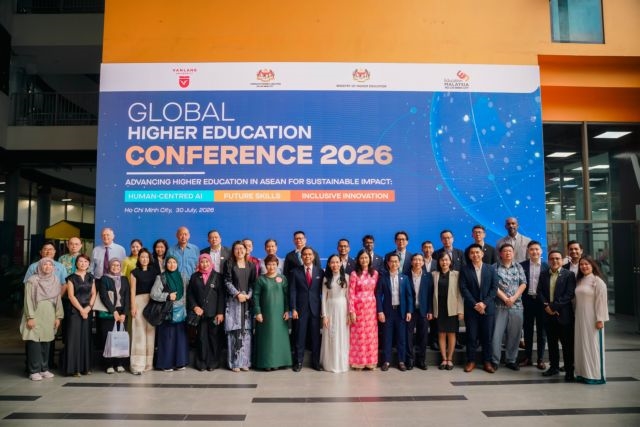
Delegates pose for a photo at the Global Higher Education Conference 2026 at Van Lang University in HCM City on July 30. |
Navigating AI in higher education
Addressing the swift transformations driven by AI across global job markets, discussions centered on how ASEAN universities can adapt through sustainable partnerships, successfully transitioning from traditional knowledge dissemination to active value creation.
Highlighting the scale of AI adoption, Prof. Dr Le Anh Vinh shared findings from a survey of 100,000 teachers and 1.3 million students conducted by the Vietnam Institute of Educational Sciences.
Following a two-year pilot program in primary and secondary schools, 90% of secondary and high school students reported using AI for their studies.
Concurrently, 82% of higher education instructors and 88% of primary school teachers have incorporated AI into their teaching.
"AI in education has moved from past debates over whether to permit or ban it, to an irreversible reality," Vinh said.
While primary educators often utilize AI for visual engagement, higher education demands a deeper integration into teaching methodologies and content structure, he said.
"The focus is no longer on surface-level engagement. It is a completely different challenge."
Experts warned against rushing AI implementation without clear pedagogical objectives.
Up to 80% of educational technology startups fail in academic settings because they stem from a technology-first, rather than an education-first, approach.
To illustrate this pitfall, Prof. Burkhard Schrage from RMIT University Vietnam cited Khan Academy’s initiative to offer every U.S. student a personalized AI tutor, which ultimately resulted in fewer than 5% of students using the tool regularly.
"If a process is already inefficient, attaching AI to it will only amplify that inefficiency," said Assoc. Prof. Alvin Ng from Nanyang Technological University in Singapore.
To integrate AI effectively, experts stressed the importance of leveraging technology for personalized interaction and fostering critical thinking, rather than merely relying on it for quick answers.
"Answers have become a cheap commodity in an AI-driven world. Conversely, asking the right questions is what makes the difference," Prof. Burkhard Schrage said.
Australian educational authorities now require at least 50% of examination assessments be designed in ways that prevent direct AI answers, leading him to evaluate his students on the quality of the questions they formulate rather than solely on their provided answers, he said.
Through keynotes exploring concepts such as the "Borderless University" and national AI strategies, speakers reached a consensus that universities are evolving into dynamic value-creation hubs linking academia, technology, and industry to resolve real-world societal challenges.
Delegates plant a tree on Van Lang University’s campus in Ho Chi Minh City on July 30, symbolizing a commitment to sustainable partnerships in ASEAN higher education.
Building sustainable educational ecosystems
Alongside the plenary presentations, thematic breakout sessions allowed delegates to delve into cross-border research collaborations, student mobility across ASEAN, and the critical role of higher education in driving regional sustainable growth.
To formalize these partnerships, several institutions and corporate entities signed Memorandums of Understanding during the event, establishing new frameworks for joint research, training, and innovation.
Commemorative tree-planting activities were also held on campus, symbolizing a shared commitment to environmental sustainability and long-lasting alliances.
The conference underscores VLU’s strategic commitment to internationalization.
Supported by a global network of over 300 partners, the university has welcomed nearly 6,000 international students from 30 countries and facilitated exchange programmed abroad for over 1,200 local students over the past five years.
Founded in 1995, the institution is ranked 251st in Asia and within the 1001–1200 bracket globally in the QS World University Rankings 2026.
Source: VNA